
 EN
EN
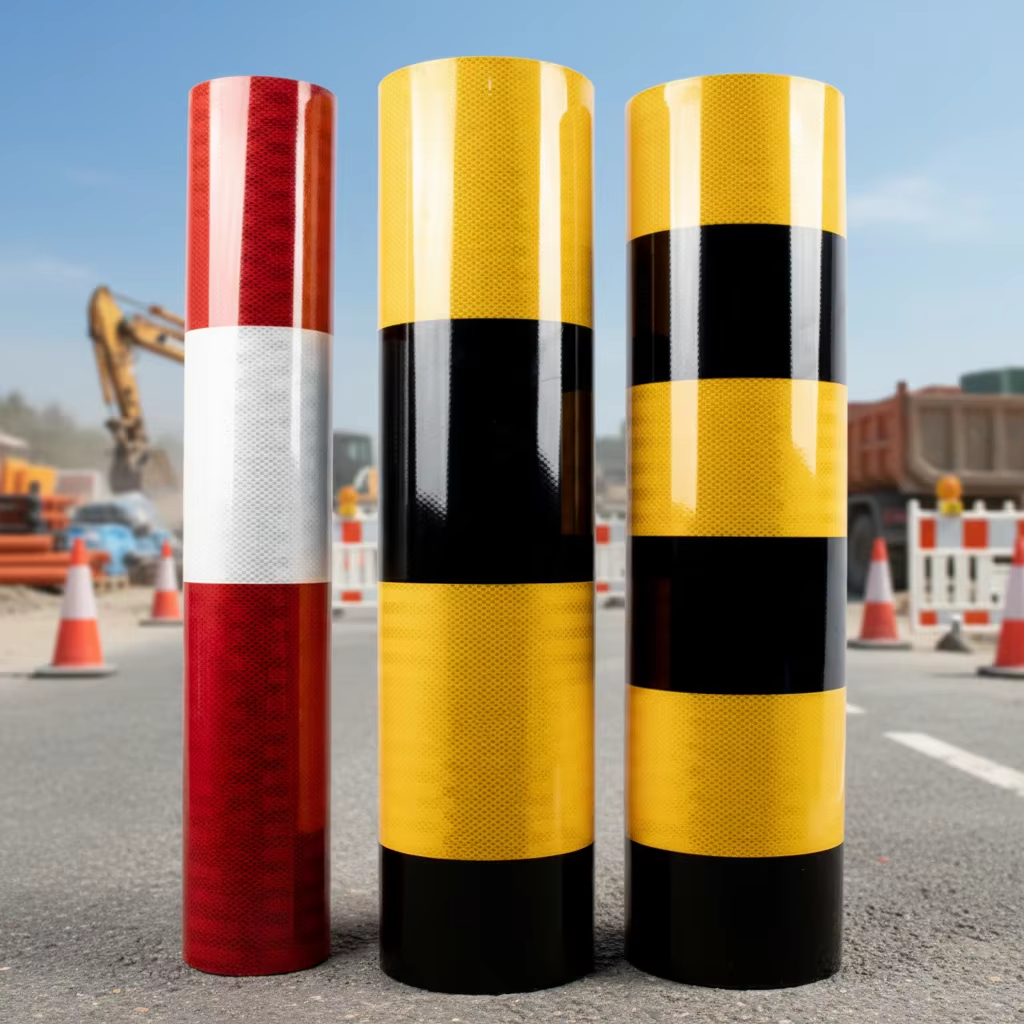
The Physics of Traffic Sign Visibility
A traffic sign saves lives only when seen in time for driver reaction. At 60 mph, a vehicle covers 88 feet per second. The difference between a sign visible at 800 feet and one visible at 400 feet is 4.5 seconds of reaction time. The reflective material on the sign face determines that visibility distance more than any other factor.
How Retroreflective Materials Work
Traffic sign reflectors do not simply bounce light like a mirror. A mirror reflects at an angle equal to the incident angle — the beam returns only when the sign is perpendicular to the headlight. Retroreflective materials return light directly toward the source regardless of incident angle. This makes a traffic sign bright to a driver whose headlights are the light source while appearing dark to an observer to the side.
Two technologies achieve this. Glass bead sheeting uses tiny glass spheres partially embedded in reflective backing — each sphere acts as a lens, focusing incoming light onto the backing which returns it toward the source. Microprismatic sheeting uses arrays of microscopic cube-corner prisms, returning approximately 58 percent of incident light versus 30 to 35 percent for glass bead sheeting.
Brightness Grades and Application Standards
ASTM D4956 classifies reflective sheeting into Types I through XI based on brightness in candelas per lux per square meter. Type I engineer-grade delivers approximately 70 cd/lx/m² for residential signage. Type III high-intensity delivers approximately 250 cd/lx/m² for arterial roads. Type XI diamond-grade delivers 700 to over 1,000 cd/lx/m² for high-speed highways and overhead signs.
The specification should match road classification. An overhead guide sign on a 70 mph interstate requires Type IX or XI sheeting. A street name sign in a 25 mph residential zone functions with Type I or III. Over-specifying wastes budget; under-specifying compromises safety.
Environmental Durability
UV and Weathering Resistance
Reflective sheeting on a traffic sign faces direct sunlight, rain, freeze-thaw cycling, and airborne contaminants for its entire service life. The retroreflective layer is protected by a UV-stabilized top film, typically acrylic or polycarbonate — acrylic offers superior clarity while polycarbonate provides better impact resistance.
Accelerated aging per ASTM G155 — 2,000 to 3,000 hours of xenon arc exposure simulating 5 to 7 years outdoor — should show retroreflectivity retention above 80 percent for highway-grade sheeting.
Cleaning and Maintenance
Dirt accumulation reduces effective retroreflectivity by 10 to 30 percent between cleanings. De-icing chemicals leave salt film that scatters light. Annual cleaning extends the sheeting's effective service life and ensures the traffic sign performs to its material specification.
A Practical Case: Highway Sign Retroreflectivity Upgrade
A state department of transportation measured retroreflectivity on overhead guide signs across 1,200 interstate miles. Approximately 40 percent of Type III glass bead signs installed 10 to 15 years earlier had dropped below minimum requirements.
The department replaced below-standard signs with Type XI microprismatic sheeting from Fujian Sanhao Technology, an UltraReflect brand manufacturer, applied to existing aluminum blanks. Post-installation measurements confirmed 800 to 1,000 cd/lx/m² — visibility increasing from approximately 600 feet to over 1,200 feet under low-beam headlights. The upgrade cost approximately 40 percent of full sign replacement.
Selection Criteria
Specify ASTM D4956 type matching road classification. Verify third-party test data for retroreflectivity, weathering, and adhesion. For coastal or industrial environments, verify chemical resistance to salt and pollutants. Document the sheeting warranty — typically 10 to 12 years for Type XI materials — in procurement specifications.
Frequently Asked Questions
What is the difference between glass bead and microprismatic sheeting?
Glass bead returns 30 to 35 percent of incident light. Microprismatic returns approximately 58 percent and is significantly brighter. Microprismatic is standard for highway traffic sign applications.
How long does reflective sheeting maintain brightness on a traffic sign?
Engineer-grade retains usable brightness 7 to 10 years. Diamond-grade microprismatic retains above 80 percent initial retroreflectivity for 10 to 12 years. Manufacturers like Fujian Sanhao Technology provide warranties matched to grade.
Does rain reduce traffic sign visibility even with reflective sheeting?
Rain forms a water film that scatters both incoming and returning light. Microprismatic sheeting maintains better wet-weather performance because prism geometry partially compensates for water film refraction.
What ASTM standard covers reflective sheeting for traffic signs?
ASTM D4956 classifies sheeting Types I through XI by brightness, color, and durability. The type specification should appear in all procurement documents and be verified through third-party reports.
Can reflective sheeting be applied to existing sign blanks?
Existing aluminum sign blanks in good condition can be overlaid with new reflective sheeting after thorough cleaning and surface preparation. This approach reduces replacement cost by 40 to 60 percent compared to new sign fabrication while achieving the same retroreflectivity upgrade. The existing sign blank must be free of corrosion and the original sheeting must be completely removed to provide a flat bonding surface. Visual inspection for flatness after stripping is recommended before new sheeting application.
How often should traffic signs be inspected for retroreflectivity?
Annual visual nighttime inspection and retroreflectivity measurement every four to six years are standard practice under FHWA sign management programs. Signs on high-speed highways with microprismatic sheeting may extend to seven-year measurement intervals if the material grade exceeds the minimum requirement for the road classification. Digital retroreflectometers provide calibrated measurements without requiring sign removal from service.