
 EN
EN
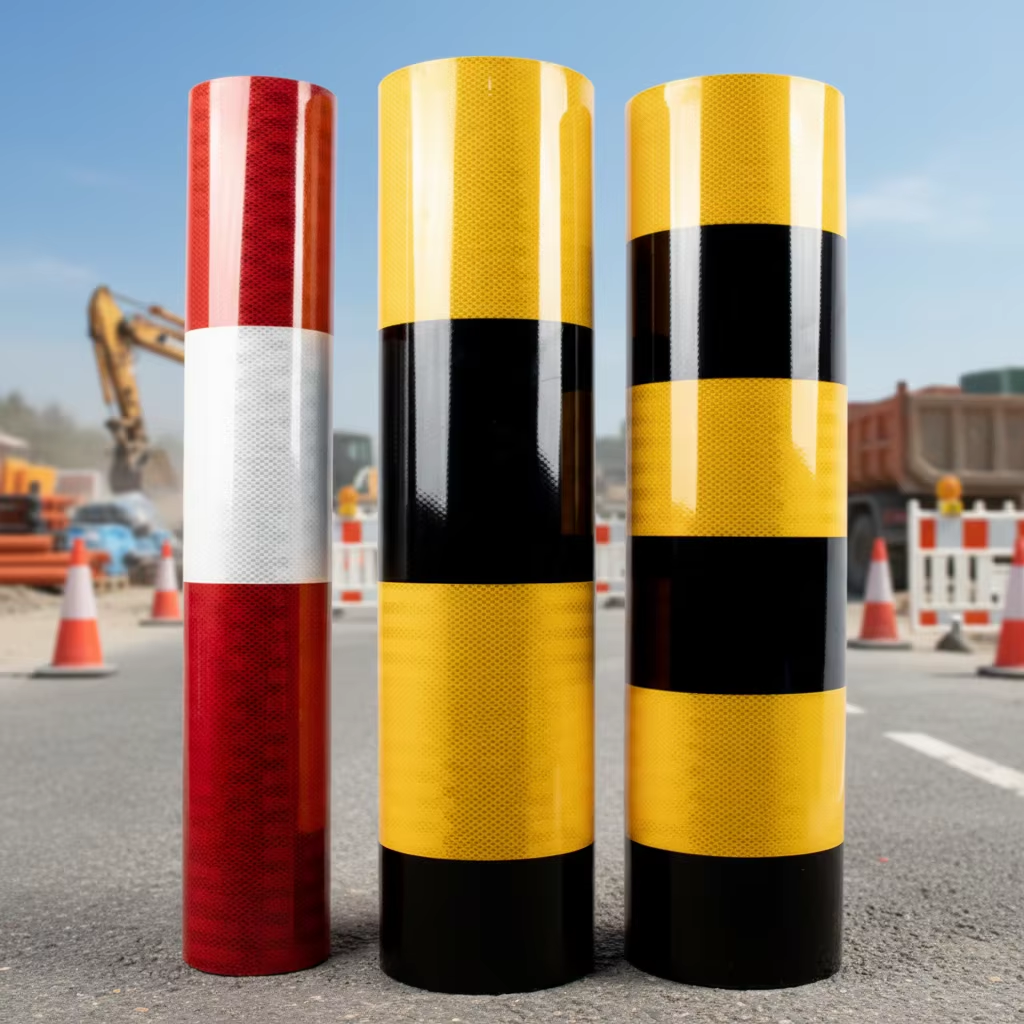
Applying Wide-Format Reflective Material to Oversized Signage Projects
Road authorities specifying directional signs for multi-lane expressways face a material logistics question: can a single reflective roll cover a sign panel measuring 3 meters wide? The answer depends on understanding roll dimensions, splicing techniques, and how retroreflective uniformity holds up across joined sections.
Reflective Roll Dimensions and Large-Sign Feasibility
Standard Roll Widths and How They Serve Oversized Panels
The reflective roll commonly supplied for traffic signage comes in widths of 122 cm (48 inches) and lengths of 45.7 meters per roll. This width accommodates most standard highway sign panels without horizontal splicing. A typical lane-direction sign measuring 120 cm × 180 cm fits within one roll width, requiring only vertical cutting to length. For gantry-mounted overhead signs spanning 3 to 5 meters, however, multiple sheets must be joined.
Sign fabricators select roll orientation based on panel dimensions. Horizontal application across the sign face — unrolling material side to side — works when panel height stays within the 122 cm limit. When both dimensions exceed roll width, splicing becomes unavoidable. The key is managing seam visibility and ensuring each section maintains identical retroreflective brightness.
Seam Splicing Techniques for Signs Wider Than 48 Inches
Butt-joining reflective roll sheets edge-to-edge creates the cleanest visual result for large traffic signs. A 1–2 mm gap between adjacent sheets prevents buckling from thermal expansion — PMMA-based sheeting expands approximately 0.07 mm per meter per degree Celsius. Over a 4-meter span at a 30°C temperature swing, that translates to roughly 8 mm of movement.
Overlap splicing, where one sheet edge covers the adjacent sheet by 5–10 mm, provides a stronger mechanical bond but creates a visible ridge line. For prismatic sheeting, the overlap region loses retroreflective function because light cannot reach the covered cube-corner elements. This method suits lower-speed urban signage where aesthetics carry less weight than durability.
Professional fabricators use a splicing jig — essentially a flat vacuum table with alignment rails — to hold sheets in position during joining. Transparent application tape applied across the seam bridges both sheets and maintains alignment during transfer to the aluminum sign substrate.
Application Techniques for Consistent Large-Format Results
Why Surface Preparation Dictates Long-Term Adhesion
A reflective roll carries a pressure-sensitive adhesive that bonds to clean aluminum, but surface contamination undermines this bond at scale. On a 4-meter panel, even microscopic oil residue from handling creates adhesion weak points. Professional shops degrease aluminum blanks with isopropyl alcohol or dedicated solvent wipes, then apply the reflective sheeting within 30 minutes — the window before atmospheric dust re-settles on the prepared surface.
Squeegee application with a roller-style applicator at 2–3 kg of pressure ensures uniform adhesive contact across the entire sheet area. Air-entrapment bubbles, the most common defect in large-format applications, are released by puncturing with a needle and re-rolling.
Minimizing Optical Variation Across Spliced Sheets
Retroreflective brightness uniformity matters for large signs because drivers traveling at highway speeds perceive the entire sign as one visual unit. Batch-matched reflective roll material — sheets produced from the same manufacturing lot — eliminates perceptible brightness differences between spliced sections. Products from manufacturers like Fujian 3HAO Technology ship with lot-number tracking, allowing fabricators to select same-batch rolls for each large sign project.
Highway Gantry Sign Replacement: A Procurement Case
A state transportation department replacing overhead guide signs on an interstate corridor needed reflective roll material for 22 gantry-mounted panels, each measuring 3.6 m × 2.4 m. The previous installation used engineer-grade sheeting that had faded below minimum retroreflectivity thresholds after 7 years. The department specified ASTM D4956 Type IV HIP prismatic sheeting for the replacement.
The sign fabrication contractor calculated material needs at 3 rolls of 122 cm × 45.7 m reflective roll per sign panel (horizontal orientation, two full-width sheets plus a spliced center section). Batch-matched rolls ensured uniform appearance across all 22 signs. Post-installation retroreflectometer measurements confirmed every panel exceeded the minimum coefficient of retroreflection at all three observation angles specified in ASTM D4956.
Frequently Asked Questions
What is the largest sign size achievable without splicing reflective roll?
Signs up to 122 cm in one dimension can be fabricated without splicing by orienting the reflective roll along the shorter panel axis. Common single-sheet sizes include 120 cm × 240 cm directional signs and 90 cm × 150 cm regulatory signs.
How visible are splice seams at night?
Butt-joined seams with a controlled 1–2 mm gap are barely perceptible in headlamp illumination at 50 meters. Overlap seams cast a thin shadow line that some drivers notice, though retroreflective performance at the seam drops only in the 5–10 mm overlap zone.
Does splicing affect sign life expectancy?
Properly executed butt splices with batch-matched rolls do not reduce overall sign durability. The adhesive bond at the seam edge matches the bond across the rest of the sheet when surface preparation and application pressure are consistent.
Can reflective roll be applied directly to plywood substrate for temporary signs?
Yes, but plywood outgassing and surface texture reduce adhesion longevity. For temporary construction zone signs (under 6 months), plywood with a sealed surface primer provides adequate performance. 3HAO recommends aluminum substrate for permanent installations exceeding one year.
What squeegee pressure prevents edge lift on large signs?
Apply 2–3 kg of roller pressure during initial application, then re-roll all edges at 4–5 kg within 15 minutes. This dual-pass technique reduces edge-lift warranty claims by roughly 60% in field data from sign fabrication shops.
Are there reflective roll products specifically marketed for large-format signs?
Most manufacturers offer wide-width rolls — 122 cm or 137 cm — specifically for large-format traffic applications. The 122 cm reflective roll standard covers the majority of highway sign fabrication needs across North American and European markets.