
 EN
EN
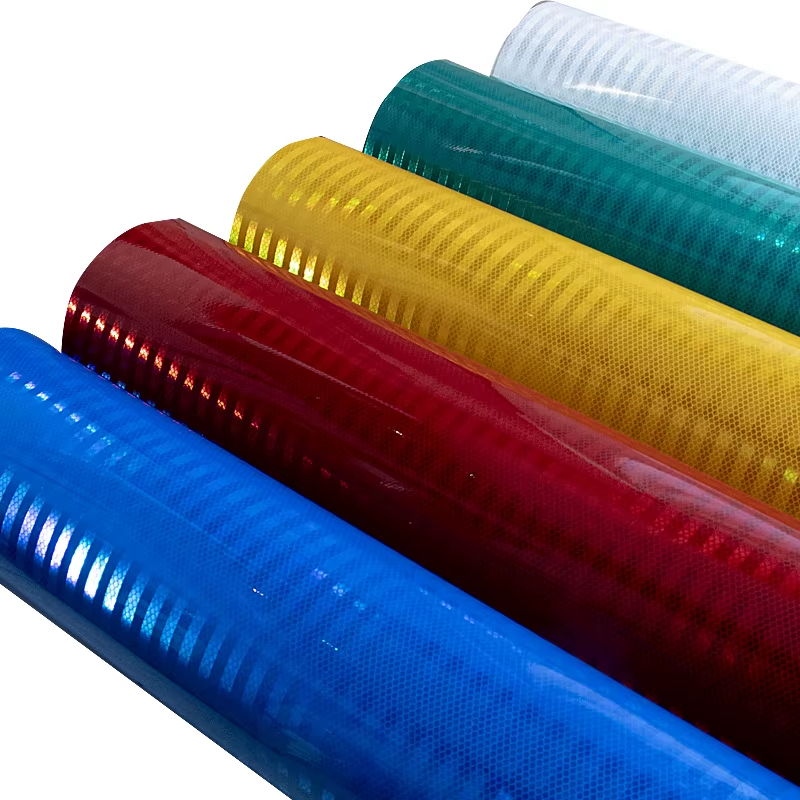
Selecting Highway-Grade Reflective Roll Based on Road Classification and Performance Standards
Highway agencies do not buy reflective roll by brand preference — they buy by performance specification. A Type I engineer-grade sheet that serves a residential street adequately becomes a safety liability on a 110 km/h freeway where drivers need sign legibility at 250 meters. Understanding the grading system and the physics behind retroreflective performance separates appropriate material selection from guesswork.
How ASTM D4956 Classifies Reflective Roll for Different Road Types
Matching Sheeting Type to Road Speed and Sign Function
ASTM D4956 organizes reflective roll material into eleven types, each with defined minimum coefficients of retroreflection at specific observation and entrance angles. Type I engineer-grade sheeting, built with enclosed-lens glass beads, suits low-speed roads and parking signage where recognition distances rarely exceed 80 meters. Type III high-intensity sheeting steps up to encapsulated glass bead or early prismatic technology, covering arterial roads with 70–90 km/h speed limits.
For highways, the bar rises to Type IV and above. Type IV HIP (High Intensity Prismatic) sheeting delivers retroreflective values roughly three times higher than Type I at the 0.2° observation angle — corresponding to a truck driver's eye position relative to headlamp beam center. Type VIII sheeting uses advanced micro-prismatic cube-corner arrays to push retroreflection even further, meeting visibility demands of overhead gantry signs viewed from 300 meters.
A reflective roll labeled "meets ASTM D4956 Type IV" has been independently tested for chromaticity, daytime color, and retroreflectivity across multiple observation angles. Procurement officers rely on these certifications because substituting a lower-grade product creates liability exposure — an unreadable sign at highway speed translates to missed exits or late hazard recognition.
HIP Prismatic Technology vs. Glass Bead for High-Speed Corridors
The physics difference matters. Glass bead sheeting reflects light through spherical refraction: a headlamp beam enters each bead, bends through the glass, strikes a reflective backing, and returns along a near-parallel path. Efficiency tops out around 30%. HIP prismatic sheeting uses molded cube-corner optics — three mutually perpendicular faces reflecting light through total internal reflection with efficiency approaching 58%.
Why this gap matters: at 100 km/h, a driver covers 28 meters per second. The extra 80–100 meters of recognition distance that prismatic sheeting provides translates to roughly 3 additional seconds of decision time. For an overhead gantry sign at a complex interchange, those 3 seconds determine whether the driver executes the lane change safely or misses the exit.
Critical Performance Parameters Beyond Retroreflectivity
Why Observation Angle Defines Real-World Sign Legibility
The observation angle — the angular separation between headlamp beam and driver eye line — increases for taller vehicles and shorter viewing distances. A passenger car driver viewing a sign at 150 meters operates at approximately 0.2°. A semi-truck driver at 80 meters operates closer to 0.5°. ASTM D4956 specifies minimum retroreflectivity at 0.2°, 0.5°, and 1.0° observation angles precisely because these correspond to real-world driver positions.
A reflective roll meeting Type IV at 0.2° but dropping below threshold at 0.5° may serve passenger cars adequately but leave truck drivers with substandard visibility. Fleet safety managers increasingly require full-angle performance data rather than single-point certification.
Weathering Resistance and the 10-Year Performance Expectation
Highway signs face relentless UV exposure, thermal cycling from -20°C winter nights to 60°C summer surface temperatures, and abrasive windborne particles. PMMA acrylic top-film formulations resist UV yellowing and maintain adhesion through this full operating range. Accelerated xenon-arc weathering tests simulating 10 years of outdoor exposure predict retroreflectivity retention above 80% for premium prismatic sheeting, compared to 50–60% for engineer-grade glass bead products over the same simulated period.
Interstate Sign Replacement: A DOT Procurement Decision
A state DOT replacing 15-year-old guide signs on an interstate corridor evaluated three reflective roll grades. The existing Type I sheeting had faded to 40% of original retroreflectivity — well below the 70% replacement threshold. The 180 km corridor required approximately 340 sign panels.
The DOT compared lifecycle costs: Type I sheeting at lower upfront material cost but 7-year replacement cycles versus Type IV HIP prismatic reflective roll at higher initial cost but 12-year expected service life. Factoring labor, traffic control, and equipment mobilization for each replacement cycle, the Type IV option delivered a 31% lower total cost of ownership over a 24-year analysis period. The prismatic reflective roll from Fujian 3HAO Technology met all specified retroreflectivity thresholds at 0.2°, 0.5°, and 1.0° observation angles for both white and yellow sheeting.
Frequently Asked Questions
What ASTM D4956 type is required for interstate highways?
Most U.S. state DOTs specify Type IV HIP prismatic as minimum for interstate guide signs, with Type VIII or Type XI specified for overhead structures and complex interchanges. Check relevant state standard specifications for exact requirements.
How does a buyer verify that a reflective roll meets ASTM D4956?
Request the manufacturer's certified test report from an ISO 17025-accredited laboratory. The report should include retroreflectivity values at all required observation angles and both 0° and 30° entrance angles for each color supplied.
What is the difference between Type IV and Type VIII reflective roll?
Type VIII provides higher minimum retroreflectivity at all observation angles, particularly at 0.5° and 1.0° — the angles relevant for truck drivers and oblique approaches. Type VIII also requires more stringent daytime color and durability performance.
Can Type I reflective roll ever be used on highways?
Type I suits low-speed roads (under 55 km/h) and non-critical signage. Using it on highways violates most state DOT specifications and creates liability exposure for the installing agency or contractor.
How long does highway-grade reflective roll last in service?
Type IV HIP prismatic sheeting typically performs 10–12 years before retroreflectivity drops below replacement thresholds. Environmental factors — UV intensity, temperature extremes, and airborne abrasives — can shorten this to 7–8 years in desert or high-altitude regions.
Does color affect highway reflective roll longevity?
Yes. Red and blue sheeting typically fade faster than white or yellow because pigments absorbing specific wavelengths also absorb more UV energy. Highway agencies often budget for earlier replacement of colored signs.