
 EN
EN
The Measurable Decline of Retroreflective Brightness and What Controls It
Every traffic sign starts bright and slowly dims. The question procurement managers and highway engineers ask is not whether reflective material loses brightness — it does, measurably — but how fast, why, and at what point the decline becomes a safety hazard. Understanding the degradation curve helps agencies plan replacement budgets and helps sign fabricators select material grades matched to expected service life.
The Physics and Chemistry of Brightness Loss
UV Radiation as the Primary Degradation Driver
Sunlight carries ultraviolet energy between 290 and 400 nanometers that breaks polymer chains in the PMMA or polycarbonate top layer protecting the retroreflective elements. Each broken chain creates a micro-scatter site — a point where incoming light deflects randomly instead of transmitting cleanly to the prismatic or glass bead layer beneath. Over years of cumulative UV exposure, the top layer transitions from optically clear to microscopically hazy, progressively blocking light from reaching and returning through the retroreflective structure.
The degradation rate correlates strongly with annual UV dose — a reflective sign in Phoenix, Arizona, receiving roughly 8,000 MJ/m² of annual solar radiation, fades faster than the identical sign in Seattle receiving approximately 4,500 MJ/m². This geographic variance explains why highway agencies in sunbelt states often specify Type IV HIP prismatic sheeting with enhanced UV stabilizer packages while cooler-climate jurisdictions may achieve acceptable service life from Type III products.
How PMMA Acrylic vs. Polycarbonate Capsules Affect Longevity
PMMA acrylic dominates premium reflective material because of its inherent UV stability. The methyl methacrylate polymer resists yellowing and maintains optical transmission above 90% through 10 years of outdoor exposure when properly formulated with UV absorbers and hindered amine light stabilizers. Polycarbonate, used in some engineered-grade products, offers higher impact resistance but yellows measurably within 3–5 years without heavy stabilization — a trade-off that limits its use in long-life highway sheeting.
The retroreflective layer itself also ages. Glass beads in enclosed-lens sheeting can detach from their binder resin as the resin oxidizes and loses flexibility. Micro-prismatic cube-corner arrays in HIP sheeting, being monolithic PMMA structures, avoid the delamination failure mode entirely — their brightness loss comes solely from top-layer hazing, which progresses more predictably and slowly.
Quantifying the Decline and Planning Replacements
Accelerated Weathering Data vs. Real-World Performance
ASTM G155 xenon-arc accelerated weathering exposes reflective material samples to controlled cycles of UV radiation, moisture, and temperature that compress years of outdoor exposure into weeks. A 2,000-hour xenon-arc test roughly simulates 5 years of subtropical outdoor exposure. Premium HIP prismatic reflective sheeting typically shows less than 15% retroreflectivity loss after 2,000 hours — translating to approximately 80–85% retention after a decade in the field.
Real-world data from state DOT sign management programs validates these projections. A 2020 FHWA-sponsored study tracking retroreflectivity on in-service signs across three climate zones found Type IV prismatic sheeting retained an average of 82% of initial brightness after 8 years, closely matching accelerated aging predictions.
Why the Replacement Threshold Matters More Than Absolute Brightness
Highway agencies do not wait until signs become illegible — they replace when retroreflectivity drops below minimum thresholds defined in the MUTCD (Manual on Uniform Traffic Control Devices). For white sheeting on guide signs, the minimum coefficient of retroreflection at 0.2° observation angle ranges from 50 cd/lx/m² for Type I to 250 cd/lx/m² for Type IV. A Type IV reflective sign starting at 400 cd/lx/m² drops to 328 cd/lx/m² after 10 years at 18% degradation — still well above the 250 minimum. A Type I sign starting at 70 cd/lx/m² that degrades 35% over the same period falls to 45 cd/lx/m², triggering mandatory replacement.
Municipal Traffic Department Retrofit Program
A city traffic engineering department managing 12,000 signs across 800 km of urban arterials adopted a data-driven replacement program using mobile retroreflectometer surveys. The asset management system flagged 3,200 signs below agency thresholds — roughly 70% of them Type I engineer-grade sheeting installed 8–10 years prior.
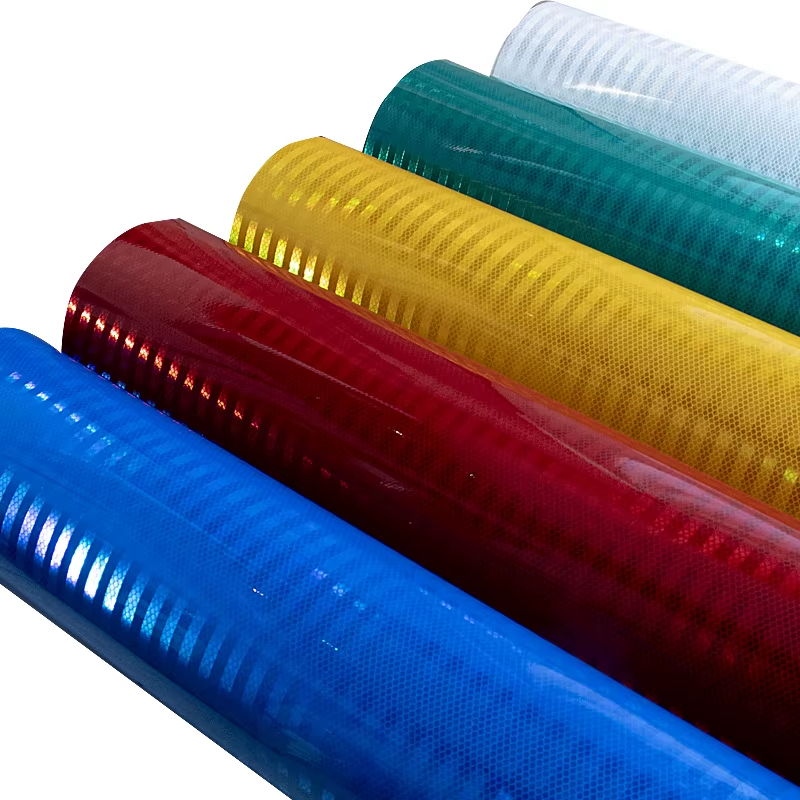
The department's procurement team sourced Type IV HIP prismatic reflective roll for the replacement program, calculating that the higher material cost would be offset by eliminating one full replacement cycle over the 20-year planning horizon. Post-installation measurements confirmed all new signs exceeded minimum retroreflectivity by 40% or more. The reflective material supplied by Fujian 3HAO Technology met chromaticity and durability requirements across white, yellow, red, green, and blue sign faces.
Frequently Asked Questions
How fast does reflective sheeting actually lose brightness?
Type I engineer-grade sheeting typically loses 30–40% of initial retroreflectivity within 7–8 years. Type IV HIP prismatic reflective material loses 15–20% over 10 years under normal outdoor exposure, with degradation accelerating slightly after year 8.
Can faded reflective material be restored?
No. Once the PMMA top layer hazes or the retroreflective elements degrade, the process is irreversible. Reflective sheeting products from companies like 3HAO are designed for replacement, not restoration. The only remedy is removing the old sheeting and applying new material.
Does color affect how fast reflective material fades?
Yes, significantly. Red and blue pigments absorb more UV energy than white or yellow, accelerating top-layer degradation. Red signs typically require replacement 2–3 years earlier than white signs of the same reflective grade in the same climate.
What environmental factor causes the most brightness loss?
Direct sunlight — specifically the UV component — causes approximately 70% of measured retroreflectivity loss. Airborne abrasives (sand, road grit) and acid rain contribute the remaining degradation through physical surface erosion and chemical attack on the PMMA layer.
How do highway agencies measure in-service sign brightness?
Mobile retroreflectometer vehicles measure signs at highway speeds using calibrated light sources and photodetectors. Handheld retroreflectometers provide spot measurements for individual signs during quality audits. Both methods reference ASTM E1709 measurement geometry.
Does reflective material degrade faster on south-facing signs?
In the Northern Hemisphere, south-facing signs receive more direct solar exposure and degrade measurably faster than north-facing signs of the same age and material. Some agencies rotate sign orientations or specify premium sheeting for south-facing installations to balance replacement cycles.